As the owner, creator, and promoter of your Faire, you are also responsible for creating the framework that you will be populating with the booths of those participants that will constitute the bulk of your event. The success or failure of your Faire will rest on your ability to create the thematic structures that will set the tone, and inspire the quality of the structures and graphics that will make up the rest of your Faire. At a minimum you will be building a front entrance, ticket booths, stages, information booths, and ale stands (if you choose). Every one of these structures will be looked at as examples of the quality you expect from your participants. If you scrimp on the appearance of these buildings then you only have yourself to blame if the rest of your event is shabby or half-heartedly constructed. This means that your structures will need to be ‘period’, well constructed, and display the very best graphics you can afford. Inspiring by example is the rule for all great Faires, and this should be foremost in your thinking as you build your event. The good news is that all other themed structures can come later, with each year adding to your growing store of buildings, graphics, and booths.
In the following pages you will find descriptions of the structures you will be designing and building, and their importance to the overall success of your Faire. Many of these buildings can come over time, but their role and influence are describe in detail.
Wednesday, May 30, 2012

Tuesday, May 29, 2012
PHOTO OPPORTUNITIES
Time was that a photo taken while on vacation ended up in a drawer, but today we live in the world of Facebook and Flickr, and more often then not images taken in the morning are posted all over the internet by that evening. The ability for people to find, share, comment on, and repurpose images taken inside your event has never been better, and let’s face it, people love getting their pictures taking in front of stuff! This means free advertising for you, and if the stuff they are taking pictures of themselves in front of has your event’s logo on it, all the better. Whenever you build any large prop or structure for your Faire, think about how your guests might interact with it. Better yet, think of how they might take a picture of themselves next to, on top of, or inside of it. This is free advertising for you, and added experience for your guests. It doesn’t get better that. So if photos of people sitting in the Queen’s sedan chair (when she is not using it), or single handed killing George’s Dragon show up on the Internet or YouTube, this is great for you and your event.
Monday, May 28, 2012
If Your Design Depends on Someone Else Doing Something to Make it Work, You Have Already Failed

The Main Stage for the Faire site was located in a perfect natural earthen bowl, which made for a wonderful theatrical experience, but the entrance to the area was easy to miss as you walked by. We would periodically hear complaints that guests could not find the stage to see the main Queen’s show, so we knew we needed to build something that would draw attention to the entrance. While at Disney a budget for a project might be 100 million dollars, at the Faire my per-Faire expense account was usually closer to $3000. I was asked to build a barker’s platform, or a small tower that I was promised a paid actor would stand upon all day and call passersby to the stage. This project ate nearly my entire budget and it generated a huge, heavy, but OSA safe platform for an actor to climb and stand upon. The morning of the first day of Faire I wandered past the stage and saw that the tower was completely missing! After hunting around I discovered that the ice delivery truck crew had dragged the tower (no small feat) and tossed it back stage. The tower was in their way, so, they moved it. After much scolding the tower was replaced, and as far as I can remember I never once saw an actor stand upon it and do anything. I did however see that a participant was stationed at the base of it all day to keep drunken guests from climbing it and falling off on their heads. Although built with all the best intentions, the design and purpose failed due to that lack of the actor to make it work as designed.
Sunday, May 27, 2012
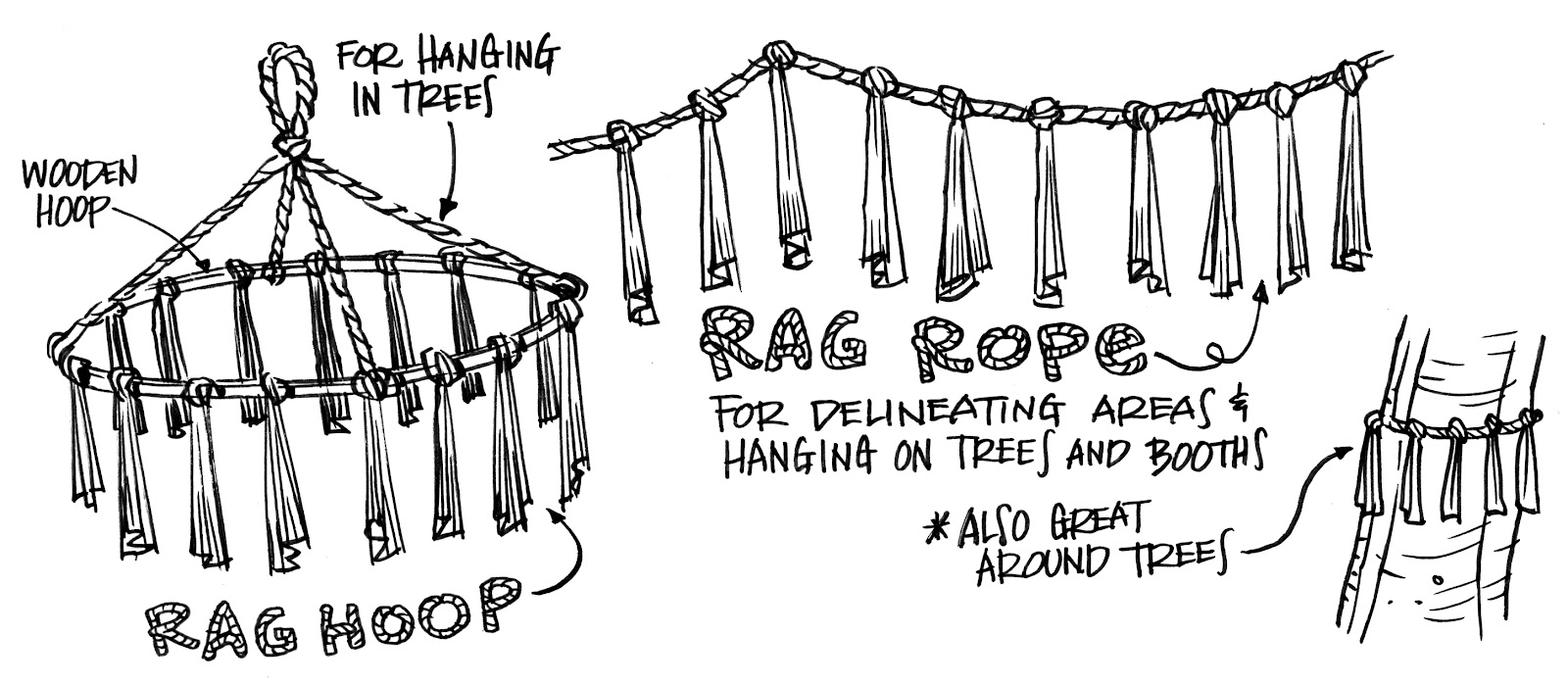
RAG ROPE
Saturday, May 26, 2012
WAY FINDING & NOMENCLATURE

Friday, May 25, 2012
GRAPHICS & SIGNAGE

Saturday, May 19, 2012
EVERY PROP TELLS a STORY
 Whether building a booth or an entire Faire you will be a wash in props to help fill out your themed environments. As you go through the expense of creating signs, objects, carts, and furniture for various areas of the event, it helps to apply a Story to it. This can be as simple as who owned it, what it was used (is being used for), and how it relates to other people and objects. This may seem alike a trifle and little worthy of the effort, but objects can have a life of their own and giving them a past helps you better judge where they will go in years to come. Just a bench doesn’t have the same weight as it being Fallstaff’s bench. Having just a cart is not as interesting as it being the “slave cart”, “wench cart” or “dung cart”. Names suggest purpose and in the larger improv environment of a large theatrical event like a Faire, being asked to pick up your mother in-law in the “dung cart” has much more potential then just a regular old cart.
WHERE'S the WIENIE?
This is a phrase stolen from Walt Disney himself. The “wienie” refers to any theme park architecture or element that helps draw the attention or interest of the visiting guests to move from one area to another. Like a carrot on a stick to encourage a horse to move forward, the wienie is a way to entice your audience to continue moving through a space. The Disneyland castle is the perfect example of a “wienie”. Guests visiting Main Street USA are compelled to move down the street by the promise of the castle that lays at the end of it. This technique works equally well within the layout of a Renaissance Faire.
A quick example… while working on the Northern California Renaissance Faire site I noticed a large Greenman figure tucked in among the trees near the front of the Faire. The figure stood over 16 feet tall and was all but invisible surrounded by the dense forest. I requested that the Greenman be moved from this location to a more prominent area under a huge oak tree at the end of a main walkway. I was cautioned that the Greenman and his location were sacred and that much ruin would fall upon me if it were to be found moved. I decided he was majestic enough to warrant relocation and promised to take the full brunt of the ill will, if there was to be any. As the Fair opened the Greenman began to evolve as little ribbons and offerings began to appear at his feet, up his arms, and inside his wooden ribcage. Rather then criticism I received countless message of praise for having finally given the Greenman a location worthy of his stature in both the Faire and hearts of it participants. What I had really done was moved a Story rich monument to a place where others could layer their Story upon him. There is nothing I could have done that would have brought more value to have much loved figure, and I created a powerful centerpiece or “wienie” to boot.
Subscribe to:
Posts (Atom)