Once you have broken beyond the 8 foot mark, the next obvious opportunity it to get a few people up there to help draw attention to your booth and wares. Although a structure that allows for the safe weight of a person can be more expensive, having a barker elevated above the heads of guests can add a dynamic quality to your booth that is more likely to draw customers to you. This is true of booth workers and performers sitting in the trunks of trees. Banter from over our head is just not something we often encounter in our modern lives, so take advantage of surprising your audience by making them look up for a change.
Showing posts with label burlap. Show all posts
Showing posts with label burlap. Show all posts
Wednesday, August 8, 2012

Sunday, August 5, 2012
CREATIVE MERCHANDISE DISPLAYS
There are practical considerations to make when creating a display for your work. Potters need sturdy shelves, expensive jewelry needs to be in a case, and fine breakables should be out of the easy reach of children. Displays also need to be something that can be easily broken down and carted home after a Faire has ended. All this being true, there is an opportunity to think outside of the conventional crafts fair display when presenting your work at a Renaissance Faire. Using organic elements like twigs and branches can create unconventional but attractive displays. Without wanting to over power your work, think of it like a flower arrangement, where your product represents each bloom. Find ways to tell the story of how your art is made. A metalworker could display a few items on an anvil, or surrounded by blacksmithing tools. A woodworker could cover the floor of his booth with wood shavings, and weaver could display baskets filled with wool in all stages from sheep to yarn. Anything you can do to your environment that speaks to the process taken to create your products will better help your customers relate to what they are looking at and eventually purchasing.
It must be added that the original Renaissance Pleasure Faire was based with the goal to recreate history, and their early booths demonstrated how their wares were crafted. It is worth considering including a work area within your booth that would allow you to work on building more merchandise for your shop. This allows your customers to better understand the workmanship that goes into each piece, creating additional interest and entertainment, and a way to keep you busy during the Faire. One thing you can do that Walmart never can is demonstrate the love and attention that goes into everything you make.
Food merchants have a harder time displaying their products, purely because the health department frowns on the presenting of uncovered food. With this in mind, food vendors have an opportunity to suggest how the food is being made. Although just behind the plywood wall and screen a booth worker may be stirring a stainless steel pot over a gas burners, but this shouldn’t stop the owner from displaying an oversized cast iron pot in a large brick hearth with the menu items painted on its side. Also creating banners and signs that depict period people eating your food, for example Henry the Eights holding a turkey leg, or a court jester juggling meat pasties is a way to suggest to the public that to eat your food is to consume a bit of history itself. The reality of running a food booth is that the experience in the kitchen is very different then that on the street, but that shouldn’t stop you from telling a story, one that takes its audience deeper into the role playing that drew them to the Faire in the first place.
It must be added that the original Renaissance Pleasure Faire was based with the goal to recreate history, and their early booths demonstrated how their wares were crafted. It is worth considering including a work area within your booth that would allow you to work on building more merchandise for your shop. This allows your customers to better understand the workmanship that goes into each piece, creating additional interest and entertainment, and a way to keep you busy during the Faire. One thing you can do that Walmart never can is demonstrate the love and attention that goes into everything you make.
Food merchants have a harder time displaying their products, purely because the health department frowns on the presenting of uncovered food. With this in mind, food vendors have an opportunity to suggest how the food is being made. Although just behind the plywood wall and screen a booth worker may be stirring a stainless steel pot over a gas burners, but this shouldn’t stop the owner from displaying an oversized cast iron pot in a large brick hearth with the menu items painted on its side. Also creating banners and signs that depict period people eating your food, for example Henry the Eights holding a turkey leg, or a court jester juggling meat pasties is a way to suggest to the public that to eat your food is to consume a bit of history itself. The reality of running a food booth is that the experience in the kitchen is very different then that on the street, but that shouldn’t stop you from telling a story, one that takes its audience deeper into the role playing that drew them to the Faire in the first place.
Thursday, August 2, 2012
Chapter Nine
BUILDING A CART
 If you like, you could always consider foregoing a traditional booth and create a cart. This is especially good if you have small items, or your larger booth has smaller products you can also sell in a satellite location. The biggest advantage to a cart is not only the smaller booth fees, but you are mobile and can rationalize moving if your first location isn’t working for you. Carts can pepper a Faire and have the advantage of being out in front of your customers and not tucked in a corner somewhere with little hope of moving. Some carts are even mobile enough to move constantly, always going where the people are.
This is very nice if you wish to park yourself at the exit when the Faire is ending, or near the stage when a big scheduled event is imminent. Carts can come in all sizes and even include places for you to sit within them. The following sketches* will give you some ideas of what a cart might be, and maybe inspire you to dream up something unique to you and your products.
* Work in progress, sketches coming.
Thursday, July 12, 2012
STURDY BOX CONSTRUCTION

Saturday, June 30, 2012
CANVAS ROOF & HARD WALLS

Friday, June 29, 2012
FABRIC TOURNAMENT BANNERS AS A MOTIF

FABRIC WALLS

Fabric Walls
This booth is constructed like the Twigs & Branches design but includes a patchwork peaked roof and back wall. This design also suggests the use of twigs and brambles as a method for displaying small hanging objects. The counter is sturdy and draped in a simple cloth. The counter could include a “lock box” that would allow you to keep valuables safe when you are away between event days.
Thursday, June 28, 2012
CHAPTER EIGHT
BOOTH BUILDING EXAMPLES
The following are some illustrated example of how materials might be used to create your own Faire booth. These are all based on a 8 foot by 8 foot booth space and are only meant to suggest techniques you could use in designing and building your own unique booth. These are also far from the limits of what is possible, so feel free to play and come up with something that will set you and your wares apart from those around you, and yet fit within the overall theme of the event.

This booth is constructed using only large branches, twigs, and poles. The booth is very open with only fabric for a roof and as a view block on the lower rail. Banners and flags decorate the booth as well as a string of colored rags tied along the front edge. This is the sort of booth a traveling crafts person would build and does not include a back space or place to lock away their products. This is a very portable design, but will require you to rope it together each time you do an event. I have seen crafts people arrive with nothing more then a pickup filled with poles and branches and miraculously erect a fantastic booth from scratch. I have to admit that I am not that brave, but I have seen it done to great effect.
The following are some illustrated example of how materials might be used to create your own Faire booth. These are all based on a 8 foot by 8 foot booth space and are only meant to suggest techniques you could use in designing and building your own unique booth. These are also far from the limits of what is possible, so feel free to play and come up with something that will set you and your wares apart from those around you, and yet fit within the overall theme of the event.

Twigs & Branches
Sunday, June 24, 2012
RAG ROLLING

When painting plywood to look like a plaster or mud surface, it is important to hide any details that might suggest that you are actually using plywood. Lower grade plywood often includes knot holes, or long running grooves or grains that are typical in this material. Before painting, be sure to fill these holes and cracks with Spackle or wood putty to hide these obvious elements that could ruin the illusion you are trying to create.
Once you have covered your plywood with a base coat, pour out a little of the base color and add a slightly darker color to it. This darker color should only be a very slight tint, almost indistinguishable from the base color. Avoid making this too great a contrasting value since it will draw attention to itself. Then, taking a cotton rag (avoid using terry cloth or a bath towel, an old cotton sheet works best) and bunch it up into a loose roll. Lightly rolling the rag roll in the slightly darker paint, then gingerly apply it to the base color by rolling the rag along its surface. Try to do this in a loose and “organic” way, avoiding symmetrical lines or stripes. Crossing the path of your rag rolling will also hide any obvious lines that might appear as to continue to mottle the surface texture.
If for some reason your end result is too busy, usually something that happens when too dark a color is applied to the base, feel free to apply another coat of watered down base color over the top. There is no wrong way to do this, but it will take some trial and error to discover a look that you like the best.
Thursday, June 21, 2012
FABRIC as a CONSTRUCTION MATERIAL
The cheapest building material by far for creating your booth or building is Fabric. Unless you are located in a particularly windy area (you don’t want your booth to become a kite), fabric is relatively inexpensive, is easily transported, and does a fabulous job of defining the walls of a structure, hiding areas of your booth you don’t want people to see or go into, and is great for roofs, awnings, and shade while still allowing light to get into your booth. Many Faires insist that all fabric used in booth construction be certified fireproof before the event opens. This can be accomplished by using pre-fireproofed material, having your fabric fireproofed and certified prior to construction, or some Faires will fireproof your booth for you, for a fee. If you are worried about being around toxic chemicals be sure to research what is being used to fireproof anything in your booth so that you are more educated about what is and is not safe.
No matter what you do to them, bed sheets look like bed sheets
When having to create booth walls, roofs, or awnings of fabric it is tempting to use something cheap and readily available, the obvious choice is to resort to used bed sheets. Although I have seen these used on countless booths, I have to say there is just something about them that cries out “BED SHEETS”! It may be the lightweight material, the color, or perhaps the types of patterns that customarily appear on them, but bed sheets actually defeat the look of a sturdy Faire booth and broadcast a lack of quality that will only cheapen the appearance of your wares.Wednesday, June 20, 2012
TRUST ME, "NO ONE PAINTED ROCKS ON PLYWOOD in the RENAISSANCE"

Wednesday, June 13, 2012
SUPPORT BUILDINGS
 As the creator of the Faire, you will find the need to supply many structures who’s purpose is not always relevant to the theme of your event. Offices, a Pass House, security, and bathrooms are just a few of the structures you may find yourself building on top of the large, and more thematically important stages and main gate. When ever possible these buildings can be placed out of the sight of your paying customers, but when that is not possible they will need some themeing to help hide them from the rest of your event. Rented construction trailers are a good place to start and they can be draped in burlap, covered with simple plywood panels depicting murals, or faux period walls. In the case of public toilet, and very specifically portable commodes, it is important to fence them off from sight from within the Faire. Our 21st century willingness to suspend our belief when it comes to using a modern toilet makes it unnecessary to theme each one, but no guests wants to herald the Queen of England as she passes a bank of port-a-potty’s.
SHADE STRUCTURES
Since we are discussing important structures that are the necessary evils of any event, we need to talk about shade. It is hard to find a Faire site or event venue that includes all of the attributes we might want, and although the site might have a good location, great parking, and enough land, often existing shade trees are sacrificed for the other three. Your booth vendors will be constructing enough shade for themselves, and potentially their immediate customers, but most of your customers will be out in the sun if there aren’t enough trees for them to congregate under. I have been to many Faires that are located in flat open fields where customers wearing period appropriate, but weather inappropriate, costumes are roasting in the sun.
If this is the case with your Faire, then you will need to take on the expense of building that shade yourself. The “easiest” solution is to construct shad structures. These can consist of telephone style poles driven into the ground and a large tarp, or more period appropriate dyed burlap can be raised like a circus tent over the audience. This is most important in spaces like theater seating, but in the case of areas where people are likely to congregate, like near food booths, shade structures are a must. Shade can be easily rationalized as not always important, but trust me when I tell you that visitors will choose to not return to an event where they have been overheated and miserable.
Monday, June 11, 2012
ALE STANDS
Often Faire promoters will choose to be one sole provider of beverages for their event. This is a smart move, and whether you chose to offer alcohol or must non-alcoholic drinks, you will become the provider of a much sought after commodity. Locating Ale Stands throughout your event, especially near food vendors, will insure a lucrative income for your event, one that can’t always be achieved with admission prices alone. Ale Stands should be designed with as much counter space as possible to allow for as many customers to be served at a time. Your Ale Stand will be popular, and you don’t want long lines to suggest your guests reconsider their thirst. Ale Stands can also be a centerpiece of festive frivolity, noise, and boisterous revelry. Including a large bell that is rung whenever someone tips is a great way to add ambience, and encourage additional tipping by those waiting to be served.
Monday, May 28, 2012
If Your Design Depends on Someone Else Doing Something to Make it Work, You Have Already Failed

The Main Stage for the Faire site was located in a perfect natural earthen bowl, which made for a wonderful theatrical experience, but the entrance to the area was easy to miss as you walked by. We would periodically hear complaints that guests could not find the stage to see the main Queen’s show, so we knew we needed to build something that would draw attention to the entrance. While at Disney a budget for a project might be 100 million dollars, at the Faire my per-Faire expense account was usually closer to $3000. I was asked to build a barker’s platform, or a small tower that I was promised a paid actor would stand upon all day and call passersby to the stage. This project ate nearly my entire budget and it generated a huge, heavy, but OSA safe platform for an actor to climb and stand upon. The morning of the first day of Faire I wandered past the stage and saw that the tower was completely missing! After hunting around I discovered that the ice delivery truck crew had dragged the tower (no small feat) and tossed it back stage. The tower was in their way, so, they moved it. After much scolding the tower was replaced, and as far as I can remember I never once saw an actor stand upon it and do anything. I did however see that a participant was stationed at the base of it all day to keep drunken guests from climbing it and falling off on their heads. Although built with all the best intentions, the design and purpose failed due to that lack of the actor to make it work as designed.
Sunday, May 27, 2012
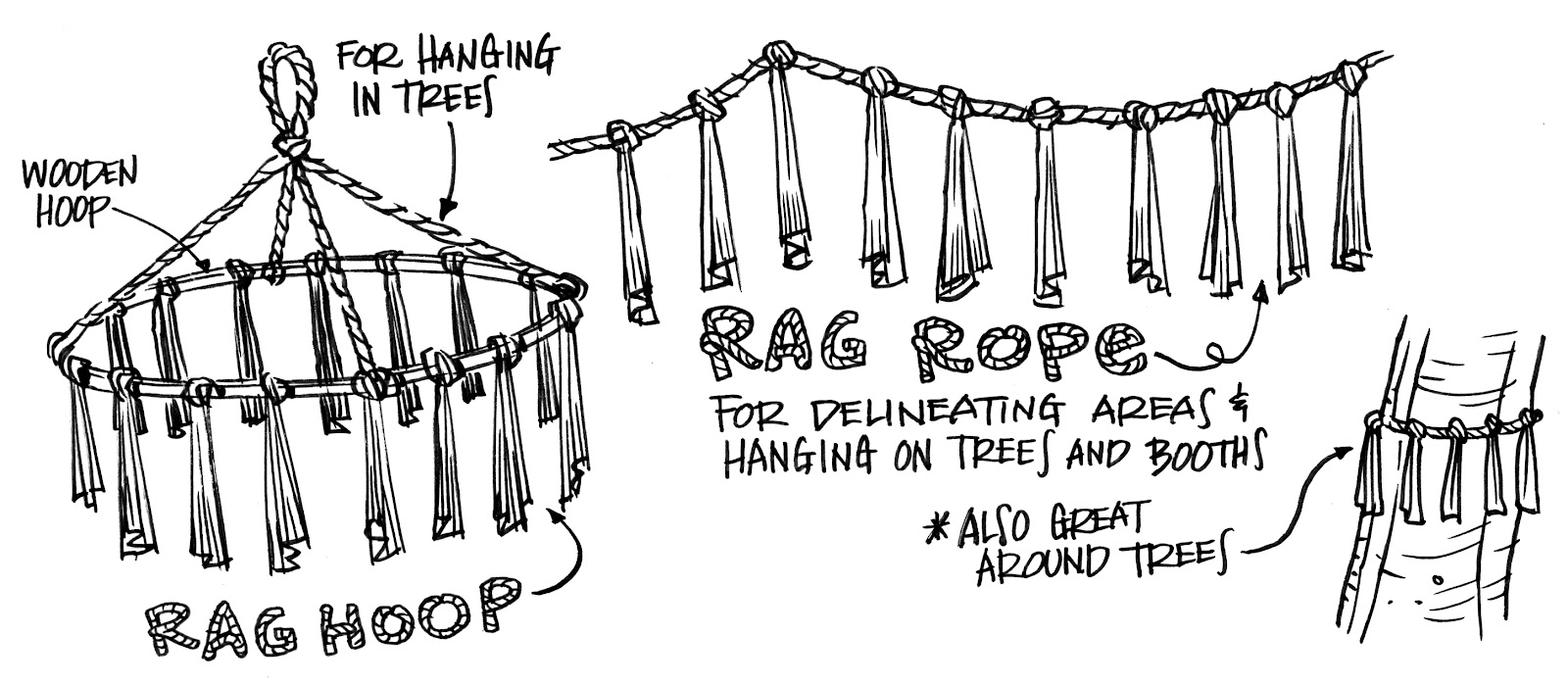
RAG ROPE
Saturday, May 26, 2012
WAY FINDING & NOMENCLATURE

Saturday, May 19, 2012
EVERY PROP TELLS a STORY
 Whether building a booth or an entire Faire you will be a wash in props to help fill out your themed environments. As you go through the expense of creating signs, objects, carts, and furniture for various areas of the event, it helps to apply a Story to it. This can be as simple as who owned it, what it was used (is being used for), and how it relates to other people and objects. This may seem alike a trifle and little worthy of the effort, but objects can have a life of their own and giving them a past helps you better judge where they will go in years to come. Just a bench doesn’t have the same weight as it being Fallstaff’s bench. Having just a cart is not as interesting as it being the “slave cart”, “wench cart” or “dung cart”. Names suggest purpose and in the larger improv environment of a large theatrical event like a Faire, being asked to pick up your mother in-law in the “dung cart” has much more potential then just a regular old cart.
WHERE'S the WIENIE?
This is a phrase stolen from Walt Disney himself. The “wienie” refers to any theme park architecture or element that helps draw the attention or interest of the visiting guests to move from one area to another. Like a carrot on a stick to encourage a horse to move forward, the wienie is a way to entice your audience to continue moving through a space. The Disneyland castle is the perfect example of a “wienie”. Guests visiting Main Street USA are compelled to move down the street by the promise of the castle that lays at the end of it. This technique works equally well within the layout of a Renaissance Faire.
A quick example… while working on the Northern California Renaissance Faire site I noticed a large Greenman figure tucked in among the trees near the front of the Faire. The figure stood over 16 feet tall and was all but invisible surrounded by the dense forest. I requested that the Greenman be moved from this location to a more prominent area under a huge oak tree at the end of a main walkway. I was cautioned that the Greenman and his location were sacred and that much ruin would fall upon me if it were to be found moved. I decided he was majestic enough to warrant relocation and promised to take the full brunt of the ill will, if there was to be any. As the Fair opened the Greenman began to evolve as little ribbons and offerings began to appear at his feet, up his arms, and inside his wooden ribcage. Rather then criticism I received countless message of praise for having finally given the Greenman a location worthy of his stature in both the Faire and hearts of it participants. What I had really done was moved a Story rich monument to a place where others could layer their Story upon him. There is nothing I could have done that would have brought more value to have much loved figure, and I created a powerful centerpiece or “wienie” to boot.
Tuesday, May 15, 2012
BLOCKING the VIEW of the 21st Century

Thursday, May 10, 2012
FAKING HISTORY

WORKSHOPS
Not all Faires do this, but I would argue that it was the “secret sauce” that made the Renaissance Pleasure Faires such a success over so many decades. Workshops are most often offered during the weekends prior to opening. This is a time when many crafts and concessions owners are present erecting their booths, and performers rehearsing their acts. These workshops are mandatory, but can be a fun way to get your head into the time period you are agreeing to participate in. These are often short, cover such things as a quick history lesson, basic steps in country dance, and a few rules for how to speak convincingly with a “Basic Faire Accent” or BFA. As you can imagine with the energy and effort everyone is going through to get their piece of the event up and ready, taking time to take a few workshops can receive a fair bit of push back, but I believe that these little refresher courses really do add up to a much better event. If nothing more it reassure that cowboy leather craftsman that merely saying “Good day good sir” and “May I help you mistress” are often enough to get by. It also makes it easier to relate to the events unfolding around you if you know whom the players are and what their roles are in the time period. At one time my wife and I booed a participant we thought was dressed as a Spaniard (the bad guys), only to later find out he was actually Sir Walter Raleigh (not a bad guy). Blush.
Monday, May 7, 2012
BUILDING HISTORY OUT of PLYWOOD, BURLAP & HAY BALES
 |
| The basic building blocks of any Faire |
Subscribe to:
Posts (Atom)