Showing posts with label trees. Show all posts

Wednesday, June 13, 2012

SUPPORT BUILDINGS

As the creator of the Faire, you will find the need to supply many structures who’s purpose is not always relevant to the theme of your event. Offices, a Pass House, security, and bathrooms are just a few of the structures you may find yourself building on top of the large, and more thematically important stages and main gate. When ever possible these buildings can be placed out of the sight of your paying customers, but when that is not possible they will need some themeing to help hide them from the rest of your event. Rented construction trailers are a good place to start and they can be draped in burlap, covered with simple plywood panels depicting murals, or faux period walls. In the case of public toilet, and very specifically portable commodes, it is important to fence them off from sight from within the Faire. Our 21st century willingness to suspend our belief when it comes to using a modern toilet makes it unnecessary to theme each one, but no guests wants to herald the Queen of England as she passes a bank of port-a-potty’s.

SHADE STRUCTURES

Since we are discussing important structures that are the necessary evils of any event, we need to talk about shade. It is hard to find a Faire site or event venue that includes all of the attributes we might want, and although the site might have a good location, great parking, and enough land, often existing shade trees are sacrificed for the other three. Your booth vendors will be constructing enough shade for themselves, and potentially their immediate customers, but most of your customers will be out in the sun if there aren’t enough trees for them to congregate under. I have been to many Faires that are located in flat open fields where customers wearing period appropriate, but weather inappropriate, costumes are roasting in the sun.

If this is the case with your Faire, then you will need to take on the expense of building that shade yourself. The “easiest” solution is to construct shad structures. These can consist of telephone style poles driven into the ground and a large tarp, or more period appropriate dyed burlap can be raised like a circus tent over the audience. This is most important in spaces like theater seating, but in the case of areas where people are likely to congregate, like near food booths, shade structures are a must. Shade can be easily rationalized as not always important, but trust me when I tell you that visitors will choose to not return to an event where they have been overheated and miserable.

Saturday, June 2, 2012

BUILDING STAGES

Apart from the investment of building your opening gate, Stages will be one of the more expensive structures you will need to build. Although there are a wide variety of types of stages you can build, your Main Stage will need to be monumental enough to allow for a fair bit of pageantry. This is where the Queen (or with some Faire’s King) will be at some point during the day, and it will need to be large enough to accommodate country dance performances and large scale period theater. A Main Stage is the perfect place to get your performers off the ground and into a balcony or elevated platform. Your Main Stage can be a character unto itself, and set the overall tone of those events scheduled on it. Other stages throughout your layout can be as small as a few hay bales and work their way up from there. A good way to think of building a new Stage is to consider it as a once-a-year addition. Each Faire you can invest in building one new Stage, or enhancing or upgrading an existing one. Stages are where the bulk of your more formal entertainment will appear, and your audience will spend a lot of their time scrutinizing them. As a rule it is always better to start with less, until you can afford more. A poor painted plywood backdrop might be less effective then nothing at all. It is prudent to avoid a cheap stage and wait until you have the funds for a proper one.

It is also important to allow for some sort of “backstage”area as part of your Stage construction. Having even a small area to rest between scenes, as well as store props and belongings, will make it easier on your performers and help them “own” the stage they will be using during the run of your Faire. Even a little pampering goes a long way to insuring your talent is happy and doing a great job. Having a stage manager or security person is also important so that props and personal belongings do not disappear.

Friday, June 1, 2012

THRESHOLDS & ARCHWAYS


While you are designing the layout of your Faire you need to keep an eye one on what the experience will be on the ground. Your audience is going to be navigating your labyrinth of booths and stages and always quietly asking themselves, “Where am I, and what is my relationship to this place?” Any opportunity that you have to help them get their bearings will make the experience more pleasurable for them. We have more fun when we feel safe and can relate to our surroundings, and always feeling lost is not fun at all. Best of all, once your audience understands where they are the more they will “own” the Faire and feel at home within it. One very powerful way to help people relate to your Faire site is to create thresholds, archways, and doorways, at each point where there is a thematic or geographic change. If I now that going under the banner labeled “Traders Market” will mean I am now in Traders Market then I can relate to both the theme and its relationship to the other areas of the Faire. If Traders Market is where your guests can find crafts and food from exotic places, they will find it easier to rediscover those wares and edibles if they wish to return.

Sunday, May 27, 2012

RAG ROPE

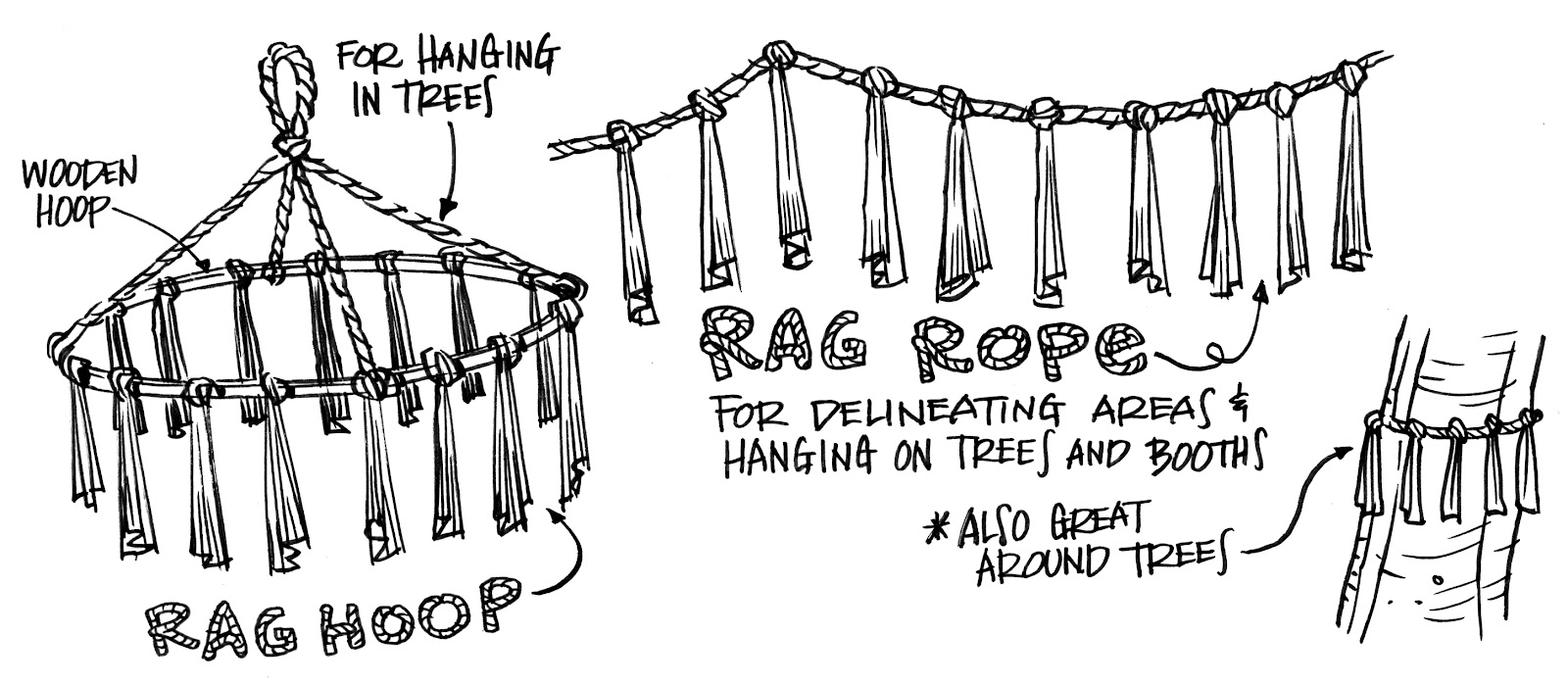
Assuming you can tie things to or suspend thing from a nearby tree (not all sites will allow this), think of ways to festoon this natural element, like a Christmas tree, with your products, décor, or just fanciful baubles. One very effective decoration is the use of “Rag Rope”. This consists of a natural looking hemp rope with brightly colored torn rags tided and hanging from it in intervals of 1 foot or so. Alternating the colors creates a festive effect that can be draped in and among the branches or be suspended between your booth a the tree. Similarly, multi-colored pennants work well, although they can look a little like a modern day used car lot if they look too new, so use with caution. Also prayer flats are very nice, but only use if there is some reason your wares have some close connection to Tibet, otherwise avoid using them. An international district or world marketplace area of the Faire could be enhanced by the use of prayer flags, as would many eastern mystics booths, but few other places are appropriate. Another variation of the Rag Rope are Rag Hoops… like the rope, “Rag Hoops” are just like they sound, a round wooden hoop, roughly the size of a Hoola-Hoop, with colorful rags tied at intervals, also suspended from tree branches look fantastic and greatly enhance the overall look of a Faire.

Tuesday, May 8, 2012

TREES, HALF of the BATTLE WON


If your Faire is lucky enough to be set amongst trees, and if you have the good fortune of having trees adjacent to your booth or stage location, then you can consider the clouds have parted and heavenly light is shining upon you. Nature is the ultimate backdrop to a successful Faire environment and will only enhance the appearance of your event. Apart from adding shade, trees, both large and small can add charm and authenticity to the mood you are trying to create, and should be taken full advantage of in your Faire designs. The most important thing to remember is that you do no harm in your partnership with the trees that make up your event or booth. This is a relationship you hope to continue to cultivate over time. Nailing into, cutting away from, or otherwise abusing the trees in and around your event will assure they are not there the following years. In the case of the Renaissance Pleasure Faire sites in the 1960’s thru 1980’s, all the trees on their property were protected Oaks and very clever ways were devised to allow coexistence between booths and trees. Despite the extra effort, it is arguable that these oaks were as much a character in the atmosphere of the Faire as the Queen’s procession and the daily jousts. Take care of your trees and police how your participants use them, and you will be assured a beautiful Faire for years to come.